Case Study | Private Sector Company

With LightOn, companies turn bid analysis into supplier decisions they can justify

How do you select a supplier quickly when every score may be questioned by a losing bidder, internal audit or management? With LightOn, the procurement team scores each bid against the RFP's own grid, with every score tied to the page that justifies it. The selection committee keeps the final decision.

Every bid read by hand, every score in the meeting notes

Selecting a supplier means reading every bidder's technical proposal and scoring it against the criteria, sub-criteria and weightings set out in the RFP.

The committee reads each proposal and scores it by hand. The reasoning behind each score lives in the meeting notes.

The analysis stretches over months, and every decision has to stand up to scrutiny: a rejected supplier asking why, an internal audit, a compliance review. A score that cannot be traced back to the bid cannot be checked, and therefore cannot be justified.

Extracting a scoring grid from the RFP, scoring free-text proposals against weighted criteria with a page-level justification, re-ranking when a weighting changes, spotting a proposal that contradicts itself: none of this fits in a spreadsheet or a document search.


The grid comes from the RFP, the scores come from the bids

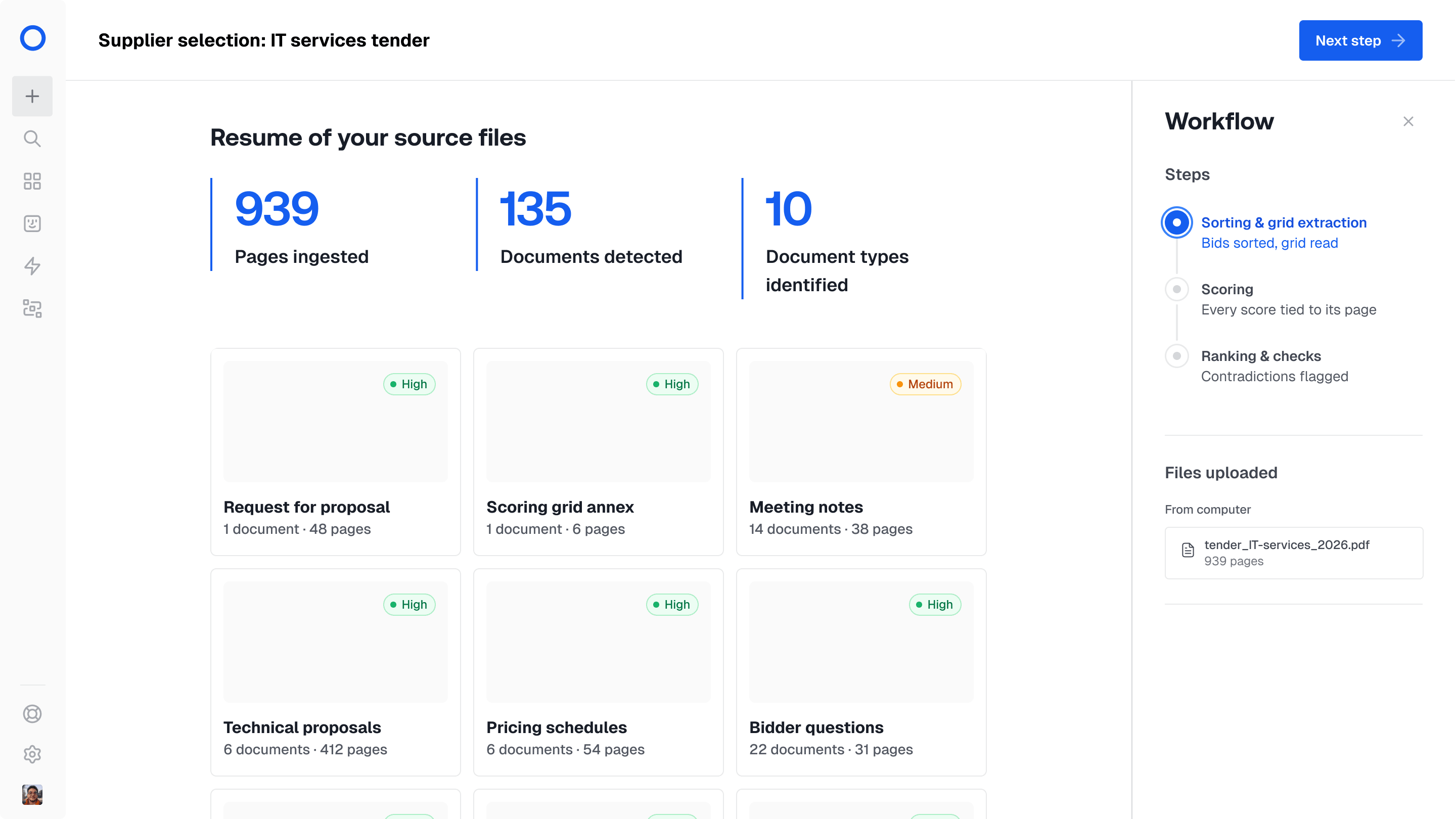
With LightOn Apps, the company set up a bid-analysis process that starts from the tender documents themselves.

  • The scoring grid is read directly from the RFP (criteria, sub-criteria, weightings) instead of being re-entered by hand.
  • Each bid is scored against that grid, and each score is justified by a passage from the proposal and its page.
  • The ranking recalculates when the buyer moves a weighting, without rerunning the analysis.
  • Each technical proposal is checked for internal consistency, to flag a bidder who contradicts itself from one section to another.

The committee receives the grid, the reasoned scoring, the ranking and the inconsistencies found.

The committee still selects the supplier. What changes is that every score now comes with the passage that supports it.

Every score stands up to scrutiny

Each score points to the passage behind it, so the decision can be explained to a rejected bidder, an auditor or the executive committee. Analysis that used to take months no longer holds up supplier selection, and moving a weighting no longer means starting over.

What used to be a long, hard-to-justify process became a decision the committee can explain line by line.


Turning a procurement process into a traceable decision

The stakes go beyond speed: a decision that can be explained, and a process that measures every bidder against the same grid.

The same approach applies wherever candidates are scored against criteria, from supplier panels and industrial RFPs to partner selection and internal project funding.

The company turned months of bid reading into supplier decisions it can explain line by line.

How are yours justified today?

Request a demo