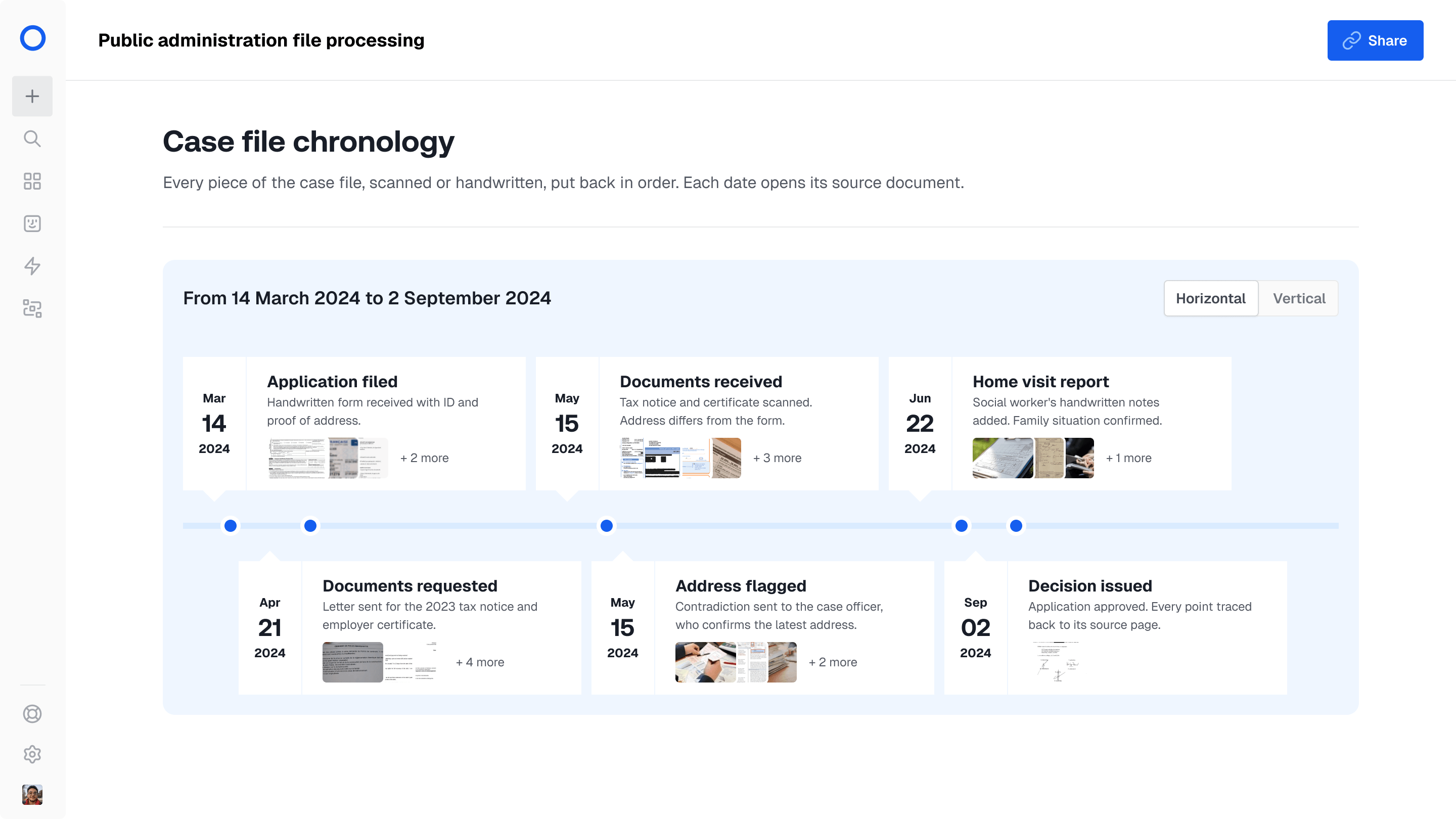
The solution developed with LightOn automates a significant part of this document analysis workflow.
Documents are first processed using LightOn's OCR and document understanding technologies to identify and extract relevant information.
The resulting data is then cross-checked across the different documents in the case, notably to compare declared information with the corresponding supporting evidence.
For each piece of information, the solution can highlight potential inconsistencies and provide a confidence level, allowing agents to focus their attention on elements that genuinely require verification.
At the end of the process, the system automatically generates a structured decision-support summary.
One of the main technical challenges was the diversity and quality of the documents, particularly handwritten material that could be difficult to interpret.
During functional validation, close to one hundred cases were analyzed, representing more than 2,000 automatically extracted fields.
Only around ten extraction errors were identified, corresponding to an error rate of approximately 0.5%.
Most of these errors involved handwriting that was particularly difficult to decipher, including for a human reader.
This level of accuracy makes it possible to automate a task that previously required careful manual reading and transcription across a very large number of documents.
The transformation goes well beyond document extraction.
Agents can now submit the documents associated with each case during the day. They are then processed automatically overnight: OCR, information extraction, consistency checks and generation of the summary sheet.
By the following morning, dozens of cases and the thousands of corresponding pages can be ready for review.
The amount of agent time required to analyze a case has consequently fallen from approximately one week to around 30 minutes, primarily focused on validating the results and making the final decision.
Across the full process, a request that could previously take several months to complete because of accumulated processing volumes can now be handled in less than a week.
Beyond document processing performance, the project came with another major requirement: the sensitivity of the data involved.
The solution had to operate within an environment meeting the particularly demanding security standards expected by French public institutions, while retaining the capacity to process several thousand pages every day.
Combining document processing performance, infrastructure control and protection of sensitive information was therefore a central requirement of the project.