Case Study | Health Research

With LightOn, research organisations map an entire scientific field in days, not months

How do you get a reliable picture of a research field when the evidence is scattered across publications, clinical trials, grants and patents, and grows every week? With LightOn, a health research organisation turned months of manual literature review into sourced landscape reports its scientific committees can act on. The experts still set the direction.

A field that moves faster than it can be read

The organisation funds and coordinates research programmes across several therapeutic areas, working with hospital teams, academic laboratories and industry partners.

Every strategic decision, whether launching a call for projects, funding a team or prioritising a topic, starts with the same question: what does the science already say, and where is it heading?

Answering it meant weeks of work for project officers and scientific advisors: querying bibliographic databases one by one, cross-checking trial registries, grant databases and patents, reading hundreds of abstracts, then consolidating everything into a report. By the time it reached the committee, part of it was already outdated. And two analysts working on the same topic rarely came back with the same picture.

Generic AI assistants were quickly ruled out: answers without verifiable sources, invented references, no access to specialised databases. For a scientific committee, a claim that cannot be traced back to a publication is worth nothing.

A research assistant that reads the whole corpus

With LightOn Apps, the organisation deployed a research assistant connected to its scientific sources: publications, clinical trial registries, research grants, patents and its own directory of experts.

  • Question framed once: the analyst picks a report format (landscape analysis, systematic review, rapid review, executive memo) and describes the topic.
  • Report planned automatically: each section gets its own targeted search queries, and independent sections are researched in parallel.
  • Evidence gathered across every corpus, with searches refined until each section is sufficiently covered.
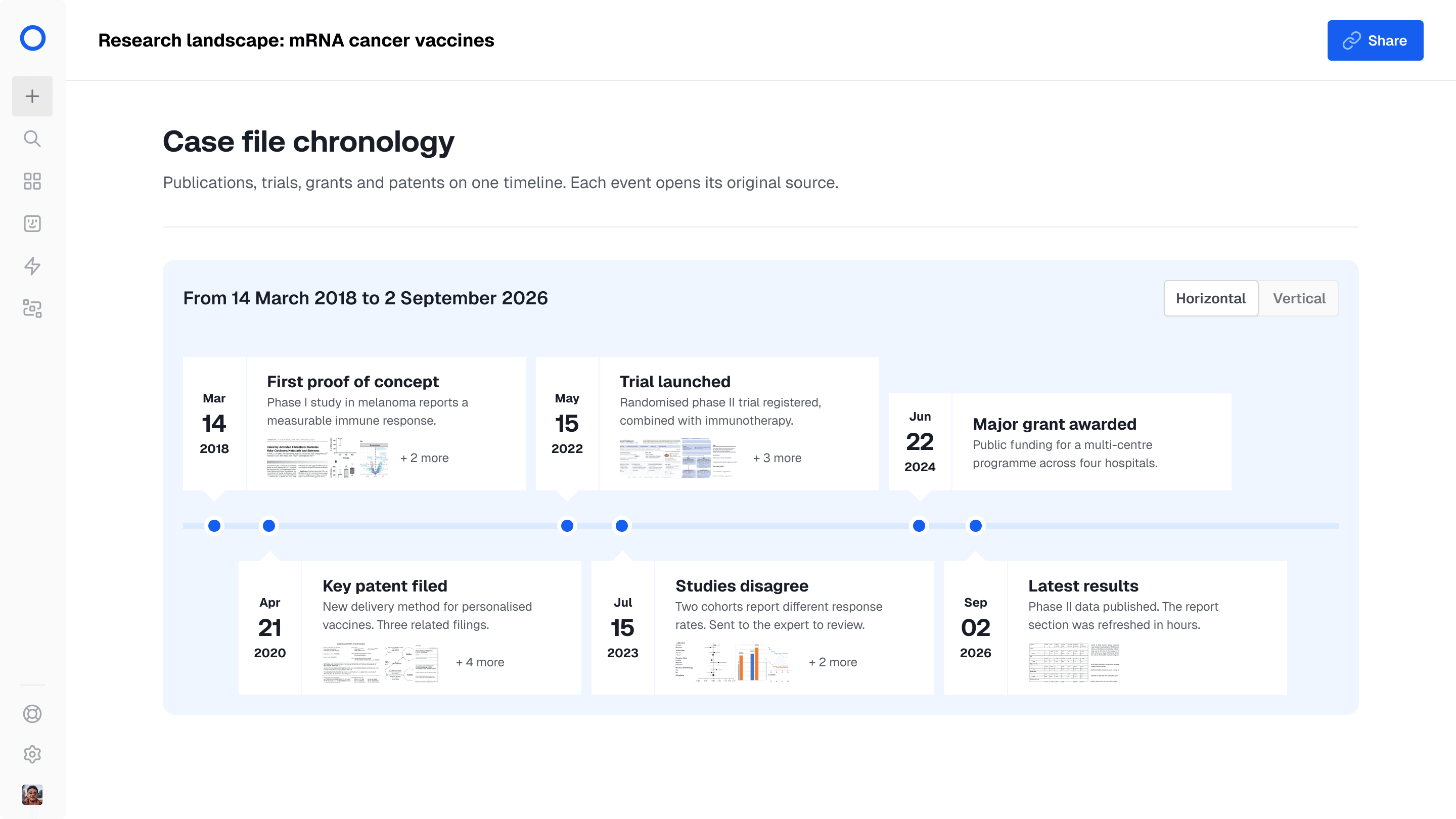
  • Every claim tied to its source: no statement without a citation, each one opening the original publication, trial or grant.
  • Contradictions flagged when two studies disagree, and sent back to the expert instead of being settled by the machine.

The analyst receives a structured report ready for review: executive summary, historical landscape, recent developments, evidence tables, clinical outlook and open questions. The full research trail (queries run, sources consulted, reasoning) remains available for audit.

The experts still decide. What changes is that every recommendation now starts from the same exhaustive, verifiable reading of the literature.

From months of review to days

Landscape reports that used to take several weeks are now produced in a few days, and refreshed in hours when a major new study is published. Analysts spend their time challenging and interpreting the evidence rather than collecting it.

Reports reach scientific committees with every statement traceable to its source, and the same method applies whatever the topic and whoever runs the analysis. The organisation now covers more fields, more often, with the same team.


Turning information overload into strategy

In research, missing a study has a real cost: a programme that duplicates existing work, a funding call that arrives too late, a promising lead left unexplored. With millions of articles published every year, no team can read everything that matters.

The organisation no longer searches the literature. It reads the field.

The organisation's evidence was scattered across a dozen databases. LightOn turned it into one sourced view of the field.

What is your team still reading by hand?

Request a demo