Case Study | Insurance

With LightOn, Insurance companies give every claim the same reading of the contract

How do you settle a complex claim quickly when the contract exists in several overlapping versions? With LightOn, claims handlers work from the exact contract in force on the date of loss, with every answer traced back to its clause. The final decision stays in their hands.

One claim, several versions of the contract

The company manages a large portfolio of contracts, each with multiple versions and amendments.

For every complex claim, the handler had to reopen the contract, its amendments, the general conditions in force on the date of loss and, sometimes, similar internal precedents. These documents change continuously, and their versions overlap.

Two handlers could read the same clause two different ways. The result: complaints, disputes, mediation referrals and eroding customer trust. Processing time for complex claims kept growing, with a direct impact on the combined ratio tracked by finance.

Identifying the contract version in force on the date of loss, reading scanned documents that arrive in bulk, reconciling the claimant's statement with the expert's report: none of this is within reach of an internal chatbot or a document search engine.

A claims assistant that starts from the right contract

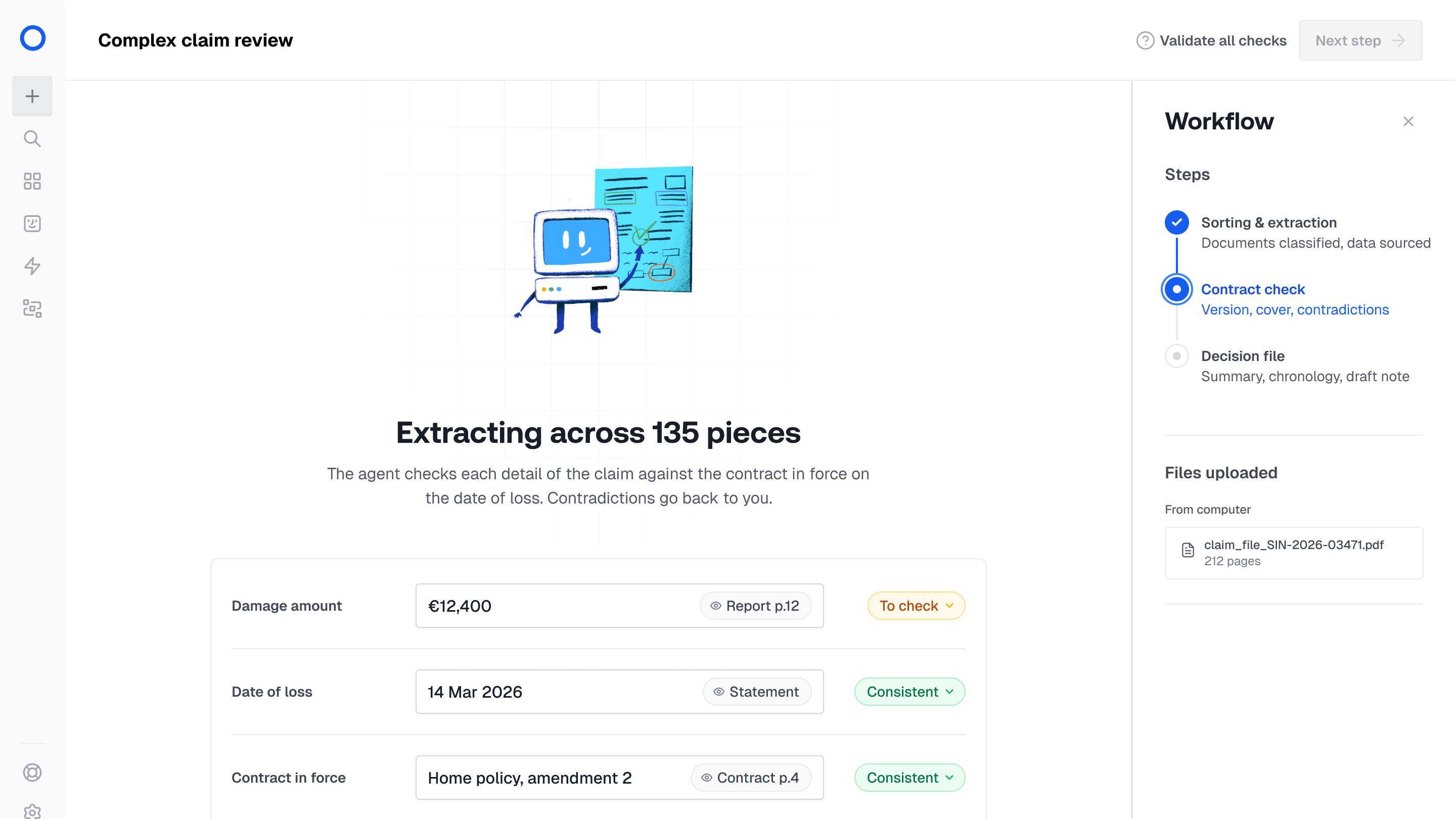
With LightOn Apps, the company deployed a claims assistant that queries the exact contract in force on the date of loss, cross-checks it against internal procedures and relevant case law, and returns an answer sourced clause by clause.

  • Documents sorted on arrival: each one is identified and classified (statement, expert report, quote, invoice, correspondence).
  • Key data extracted, each value linked to its source page.
  • Right contract version selected for the date of loss, and cover checked.
  • Statement and expert report reconciled: any contradiction goes back to the handler instead of being settled by the machine.
  • Chronology rebuilt, with each date opening its source document.

The handler receives a claim file ready for decision: summary sheet, chronology, applicable cover, points to check and a draft decision note. Every element points back to its clause or document.

The handler still decides. What changes is that every decision now rests on the same consistent, justifiable basis, whatever the file and whoever handles it.

Faster files, fewer disputes

Complex claims are processed faster. Differences in interpretation between handlers have dropped sharply, and so have complaints linked to misapplied contract terms.

What used to weigh on the combined ratio and customer satisfaction is now presented to the executive committee as a proof of consistency and speed.


Turning the moment of truth into a strength

A claim is an insurer's moment of truth: it is where the commercial promise gets tested.

By working from the right contract every time, the company turned its most exposed process into one it can stand behind, file after file.

The company turned overlapping contract versions into one clear answer per claim.

What are your handlers still reopening by hand?

Request a demo